
Pritam Gurumayum, VP, Marketing, RatnaGlobalTech, LinkedIn profile
Artificial Intelligence is no longer a futuristic concept in healthcare. It is increasingly becoming part of how healthcare organizations manage information, improve operational efficiency, support clinical workflows, and expand access to care.
From intelligent patient triage and predictive analytics to telemedicine and digital health records, AI is creating new possibilities across the healthcare ecosystem.
But from my perspective, the real opportunity with AI in healthcare goes beyond automation. The objective should not simply be to make healthcare more digital; it should be to make healthcare more accessible, connected, data-driven, efficient, and patient-centric.
At Ratna Global Tech, we believe technology delivers meaningful value when it solves real-world challenges. This philosophy is reflected in Ratna HealthPlex, our healthcare technology platform that brings together AI, telemedicine, Electronic Medical Records (EMR), laboratory management, pharmacy operations, and healthcare interoperability into a connected digital ecosystem.
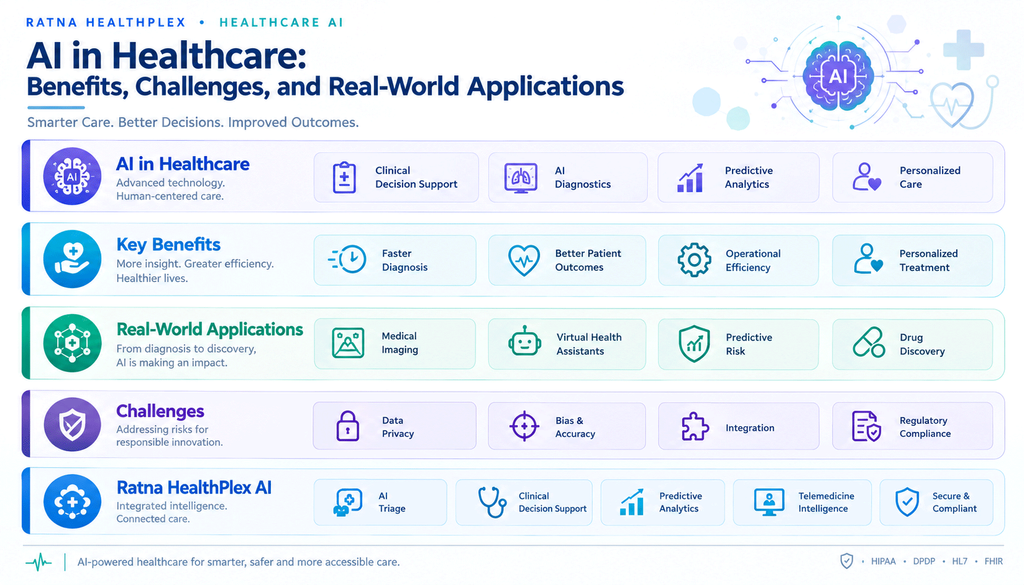
What Does AI Mean for Healthcare?
AI in healthcare encompasses technologies such as machine learning, natural language processing, predictive analytics, computer vision, and intelligent automation.
These technologies can process large volumes of information, identify patterns, generate insights, and automate repetitive processes.
However, I believe an important principle must remain at the centre of healthcare AI: AI should augment human expertise, not replace it.
Doctors, nurses, administrators, and other healthcare professionals bring experience, judgment, empathy, and accountability that technology cannot replicate. AI should give them better information and better tools to make informed decisions.
The Benefits of AI in Healthcare
1. Improving Healthcare Efficiency
Healthcare organizations manage enormous volumes of patient, laboratory, pharmacy, and administrative information.
AI-powered automation can reduce repetitive work, streamline workflows, and allow healthcare professionals to focus more of their time on patient care.
A connected healthcare platform can further improve efficiency by bringing EMR, laboratory, pharmacy, telemedicine, and AI-enabled workflows together instead of requiring teams to operate across disconnected systems.
Ratna HealthPlex is designed around this connected approach, integrating EMR, LIMS, pharmacy operations, telemedicine, and AI capabilities within a unified healthcare environment.
2. Turning Healthcare Data Into Actionable Insights
Healthcare generates data across almost every stage of the patient journey.
The challenge is not simply collecting this information. The real challenge is turning it into meaningful insights.
AI and analytics can help healthcare organizations understand:
- Patient trends
- Disease incidence
- Resource utilization
- Facility performance
- Clinical outcomes
- Healthcare demand
- Operational efficiency
For healthcare leaders, this can support more informed, data-driven decision-making.
3. Supporting Clinical Decision-Making
AI can also play an important role in Clinical Decision Support Systems.
By analyzing available patient information, AI can highlight relevant patterns, potential risks, or useful information that healthcare professionals can consider during care delivery.
Ratna HealthPlex incorporates Clinical Decision Support System (CDSS) capabilities and digital prescriptions, including drug-interaction checks within the healthcare workflow.
The important distinction is that technology provides support while clinical responsibility remains with qualified healthcare professionals.
4. Expanding Access Through Telemedicine
Healthcare accessibility remains a major challenge, particularly for communities where specialist availability, infrastructure, or connectivity can be limited.
Telemedicine can help bridge some of these gaps by enabling patients to connect with healthcare professionals remotely.
AI can further enhance telemedicine through:
- Intelligent patient intake
- AI-assisted triage
- Patient information processing
- Virtual assistants
- Clinical workflow support
- Contextual hand-offs between care stages
Ratna HealthPlex’s adaptive telemedicine capabilities are designed to support 2G/3G environments, helping digital healthcare reach areas where high-speed connectivity may not always be available.
For me, this is an important part of the AI conversation: innovation should not be limited to environments with perfect infrastructure.
Real-World Applications of AI in Healthcare
AI Triage and Pre-Diagnostic Support
AI-powered triage is emerging as an important healthcare application.
Instead of simply collecting patient information, intelligent systems can analyze symptoms and available vital information to help prioritize cases and support further clinical evaluation.
Ratna HealthPlex’s AI Triage & Pre-Diagnostic Edge Module (ATPeM) combines voice-first, contextual, and low-bandwidth AI capabilities.
Its edge-oriented approach is designed to support point-of-care intelligence, including environments where connectivity may be limited or unavailable.
This type of technology has particular potential in underserved communities where access to healthcare professionals and digital infrastructure may be constrained.
AI-Powered Healthcare Analytics
Healthcare organizations generate information across clinical, administrative, laboratory, pharmacy, and operational departments.
When this information is connected and analyzed effectively, it can provide valuable insights into how healthcare services are being delivered.
AI-powered analytics can help organizations understand:
- Patient volumes
- Disease incidence
- Resource allocation
- Facility utilization
- Clinical outcomes
- Healthcare demand
Ratna HealthPlex incorporates operational analytics designed to support reporting and decision-making across these areas.
AI in Pharmacy Management
Pharmacy operations involve much more than dispensing medicines. They include inventory management, prescriptions, pricing, availability, and medication optimization.
AI can support pharmacy operations by analyzing inventory and pricing information and identifying potentially more affordable alternatives where clinically appropriate.
Ratna HealthPlex’s AI Medicine Cost Optimizer is designed to compare local pharmacy pricing and inventory information and identify potentially lower-cost generic alternatives.
Technology should not only make healthcare smarter. It should also contribute to making healthcare more affordable and accessible.
AI and Electronic Medical Records
Electronic Medical Records are becoming a central component of modern healthcare delivery.
AI can help organize and analyze information within healthcare records, potentially making relevant information easier to access during patient care.
When AI is integrated directly into an EMR workflow, healthcare professionals can receive intelligent assistance without constantly switching between disconnected systems.
Ratna HealthPlex connects clinical EMR and workflow capabilities with laboratory, pharmacy, telemedicine, and other healthcare services to create a more integrated digital healthcare environment.
AI and Laboratory Management
Laboratories generate significant volumes of diagnostic information.
A connected Laboratory Information Management System can help streamline test ordering, report generation, result management, and diagnostic workflows.
When laboratory information is connected to the patient’s broader healthcare record, relevant diagnostic information can become part of the overall care journey.
Ratna HealthPlex integrates LIMS with EMR, telemedicine, and pharmacy operations, supporting a connected healthcare workflow.
AI and Healthcare Equity
One of the questions I believe the industry needs to ask is:
Are we using technology only to improve healthcare for those who already have access, or are we using it to close healthcare gaps?
AI has the potential to support healthcare equity by helping organizations identify gaps in access, resources, specialist availability, and healthcare delivery.
Ratna HealthPlex incorporates an AI Health Equity Index™, designed to monitor healthcare gaps and support more equitable allocation of healthcare resources.
This represents an important shift—from simply making healthcare digital to making healthcare more accessible and equitable.
AI, ABDM, and Healthcare Interoperability
AI can only be as effective as the quality, availability, and governance of the data it works with.
Healthcare organizations often operate separate systems for:
- EMR
- Laboratory management
- Pharmacy
- Telemedicine
- Patient portals
- Administration
Interoperability allows these systems to communicate and exchange information more effectively.
Ratna HealthPlex supports healthcare interoperability through frameworks and standards including HL7, FHIR, and ABDM, while emphasizing responsible data management, consent, and security.
For India’s rapidly evolving digital healthcare ecosystem, interoperability will be an important foundation for connected care.
Protecting Patient Data in an AI-Driven Healthcare Environment
Healthcare data is among the most sensitive forms of personal information.
As AI adoption grows, organizations must ensure that innovation does not come at the expense of privacy, security, or patient trust.
Key considerations include:
- Data encryption
- Consent management
- Role-based access
- Audit trails
- Secure data storage
- Regulatory compliance
- Responsible AI governance
Ratna HealthPlex emphasizes HIPAA and DPDP Act 2023 considerations, along with granular consent management and auditability for patient data.
In my view, trust must be treated as a core feature of healthcare technology—not an afterthought.
Challenges of AI Adoption in Healthcare
The opportunities are significant, but responsible implementation requires addressing several challenges.
Data Quality
AI depends on reliable data. Incomplete, inaccurate, inconsistent, or poorly structured healthcare data can affect the quality of AI-generated insights.
Privacy and Cybersecurity
Healthcare organizations need strong safeguards across the entire data and AI lifecycle to protect sensitive patient information.
Integration With Existing Systems
Many healthcare organizations rely on legacy systems. Introducing AI without disrupting existing workflows can be challenging.
Bias and Fairness
AI systems can reflect biases present in their training data. Continuous validation, monitoring, and responsible governance are therefore essential.
Explainability
Healthcare professionals may need to understand how an AI system reached a particular recommendation or insight, particularly when technology is used in clinical workflows.
Human Oversight
AI should operate with appropriate human oversight, particularly in situations involving clinical decision-making.
Digital Accessibility
A sophisticated digital healthcare solution has limited impact if patients cannot use it because of connectivity, language, device, or infrastructure limitations.
This makes low-bandwidth, multilingual, and accessible healthcare technology increasingly important.
What Does the Future of AI in Healthcare Look Like?
I believe the future of healthcare will involve deeper integration between AI, telemedicine, EMR, analytics, laboratory systems, pharmacy management, and interoperable digital infrastructure.
The industry is moving from isolated technology solutions toward connected digital healthcare ecosystems.
However, particularly for underserved communities, the next generation of healthcare AI must solve more than technical problems.
It must address:
- Connectivity
- Affordability
- Language accessibility
- Data ownership
- Healthcare workforce limitations
- Specialist availability
- Patient trust
The most meaningful healthcare AI solutions will therefore combine intelligence with accessibility, security, interoperability, and human-centered design.
How Ratna HealthPlex Brings AI and Healthcare Together
At Ratna Global Tech, our approach is to look at healthcare technology as an ecosystem rather than as a collection of disconnected applications.
Ratna HealthPlex brings together:
- AI-powered healthcare capabilities
- Electronic Medical Records
- Telemedicine
- Laboratory Management
- Pharmacy Management
- Healthcare Analytics
- Clinical Decision Support
- Healthcare Interoperability
The platform is designed to support connected healthcare delivery while addressing real-world challenges such as limited connectivity, resource constraints, affordability, and healthcare access.
From AI-assisted triage and analytics to digital records, pharmacy optimization, telemedicine, and interoperable healthcare data, an integrated approach can help healthcare organizations build more connected and efficient care delivery models.
Conclusion
AI is already changing healthcare.
But the success of healthcare AI will not be measured only by how sophisticated an algorithm is. It will be measured by how effectively that technology improves healthcare outcomes, supports professionals, protects patient information, and expands access to care.
We need to build healthcare technology around high-quality data, secure infrastructure, interoperability, responsible governance, human oversight, and accessibility.
When these elements come together, AI can help create healthcare systems that are smarter, safer, more efficient, and more equitable.
At Ratna Global Tech, we see the future of healthcare not as AI replacing people, but as AI empowering people.
The future will belong to healthcare ecosystems where technology, healthcare professionals, patients, and data work together to deliver better care.

VP, Marketing, RatnaGlobalTech.