
An agency director in Texas told me the denial she hated most. A skills training note, written carefully, signed on time, billed under the right code. Denied forty-five days later because the client’s authorization had run out of units eleven days before the visit. Nobody had done anything wrong on the day. The information that would have prevented it existed in three places, and none of them was the note editor.
Community behavioral health is the specialty where the gap between clinical work and payment is widest and the rules are most specific. Medicaid managed care organisations, level-of-care instruments, fifteen-minute units, credential-restricted codes, co-signature requirements, state reporting systems, 42 CFR Part 2. A general-purpose EMR handles it the way a general-purpose EMR handles anything: with free text and a billing department that finds out later.
HealthPlex Behavioral Health models the whole chain, from referral to payroll, as fourteen stages with a gate at each. This post walks the chain with Texas Medicaid as the worked example, because the worked example is what makes the architecture concrete.
Fourteen stages
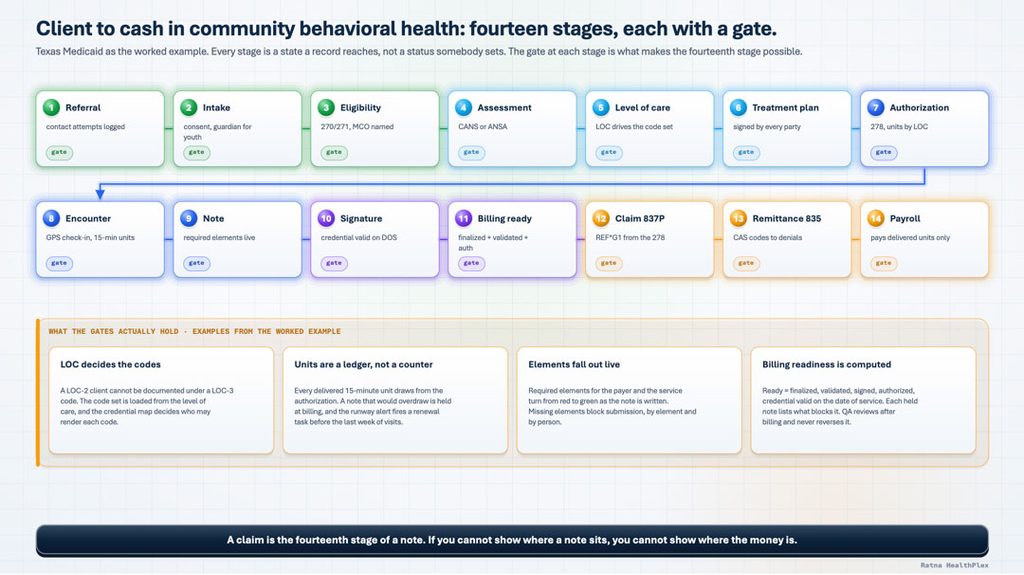
Figure 1: Client to cash in community behavioral health: fourteen stages, each with a gate.
A stage is a state the record reaches, not a status somebody sets. The distinction matters. “Intake complete” is not a dropdown; it is what the platform says when consent is captured, a guardian is on file for a minor, and eligibility has been verified. If the record has not reached the state, no one can mark it as if it had.
- Referral. Captured from an outreach event, a public form, a phone call. Contact attempts are logged; the third unsuccessful attempt nudges a disposition.
- Intake. Consent, and for anyone under eighteen a guardian or legally authorised representative. The enrolment cannot proceed without them.
- Eligibility. A 270/271 exchange confirms Medicaid coverage and names the managed care organisation, which decides which contract and which rules apply.
- Assessment. CANS for youth, ANSA for adults, completed through the state system where the state requires it.
- Level of care. Derived from the assessment, and the single fact that drives the next four stages.
- Treatment plan. Goals, objectives, interventions. Signed by every party the payer expects to sign, including the client or guardian.
- Authorization. A 278 request to the MCO sized by the level of care: which code, how many units, for how long.
- Encounter. The visit happens, often in the community with GPS check-in, and is measured in fifteen-minute units.
- Note. Written against a template for that service and that payer, with the required elements visible as the note is written.
- Signature. By a rendering provider whose credential permits the code on the date of service, with a supervisor’s co-signature where the credential requires one.
- Billing ready. Computed, not declared.
- Claim. An 837P carrying the authorization reference from the 278 and both providers where co-signature applies.
- Remittance. An 835 whose adjustment codes become denials with root causes, or payments posted against the claim.
- Payroll. Providers are paid for delivered units, and a note that cannot be billed is a note that is not yet payable.
The director’s denial happened between stages 7 and 8. The authorization ledger knew the units were exhausted. The scheduler did not ask it.
The gates that do the work
Four of the gates carry most of the weight.
Level of care decides the code set. A client at LOC-2 has a set of codes and an authorization shape that goes with it. A note for a LOC-3 service cannot be written for a LOC-2 client; the template is not offered. When a reassessment changes the level, the change raises a reauthorization task before anyone documents against the new level.
Units are a ledger, not a counter. Every delivered fifteen-minute unit draws from the authorization the way a debit draws from an account. Scheduled visits do not draw; delivered ones do. A note that would overdraw the authorization is held at billing readiness with the reason stated, and the runway alert fires a renewal task when fewer than a week of visits remain. The director’s eleven-day gap would have been a task three weeks earlier.
Required elements fall out live. Each payer and each service has a list of elements a note must contain: the intervention, the client’s response, progress toward a specific goal, the time in and out, the location. As the clinician writes, the elements turn from red to green. Missing elements block submission. After billing, quality review works from the same element list, and its findings are tracked by element and by person, so a supervisor sees that one clinician keeps omitting the response to intervention rather than that “notes need work”.
Billing readiness is computed. A note is ready when it is finalized, has passed validation, is signed by a permitted credential valid on the date of service, and the authorization has units to cover it. Each held note lists what blocks it. Quality assurance reviews after billing and never reverses a bill; corrections are addenda with their own record, and a billing hold is reserved for material findings.
Credential, level of care, service
The rule that stops the largest number of denials is a mapping the agency already has in its head and has never had in its software: which credentials may render which codes, at which level of care, with or without co-signature.
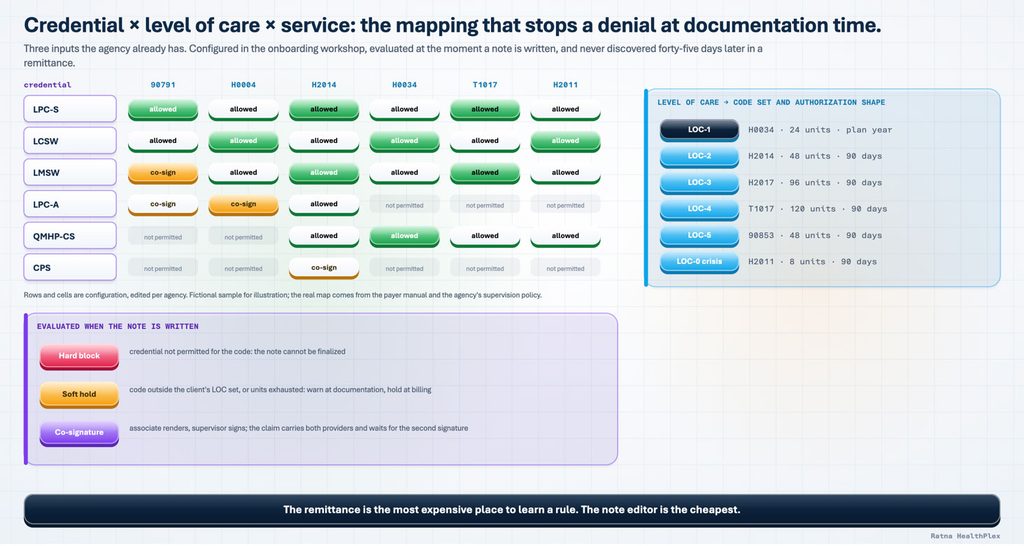
Figure 2: Credential × level of care × service: the mapping that stops a denial at documentation time.
The map is configuration, edited in the onboarding workshop from the payer manual and the agency’s supervision policy. A licensed associate may render individual counselling with a supervisor’s co-signature; a qualified mental health professional may render skills training and case management but not a diagnostic evaluation; a peer specialist has a narrower set again. The level of care contributes the second axis: which codes are in the client’s set and how many units the authorization typically carries.
The map is evaluated when the note is written, not when the claim is built. A credential that is not permitted for the code is a hard block; the note cannot be finalized. A code outside the client’s level-of-care set, or an exhausted authorization, is a soft hold: warned at documentation, held at billing. A co-signature requirement routes the note to the supervisor’s queue and holds the claim until the second signature arrives, and the claim carries both providers.
The remittance is the most expensive place to learn a rule. The note editor is the cheapest.
Part 2 and the segmented record
Substance use records under 42 CFR Part 2 need their own disclosure consent, separate from the general consent to treat. The platform segments those records at the data layer and the consent registry holds the Part 2 consents with their expiries. A request to release the chart to a primary care provider releases the behavioral health record and refuses the Part 2 segment unless a specific consent covers it. The refusal is logged. When we show this to agencies, we show the log, because the refusal is the feature.
Configuration, not code
Everything above is configuration: the level-of-care map, the code sets, the credential rules, the required elements per template, the automation rules that raise tasks. Agencies differ from one another in exactly these tables, and an agency’s rules change when a payer manual changes. A platform that needs a developer for any of it will be out of date within a quarter.
If you run a community behavioral health agency and you are evaluating software, ask one thing: show me where a note sits. If the vendor can point at a stage, name the gate holding it, and show the same view for the money, you are looking at a platform. If they can show you the note and separately show you the claim, you are looking at two systems with a gap between them, and the gap is where the denials live.

CTO and ChiefArchitect, RatnaGlobalTech.