
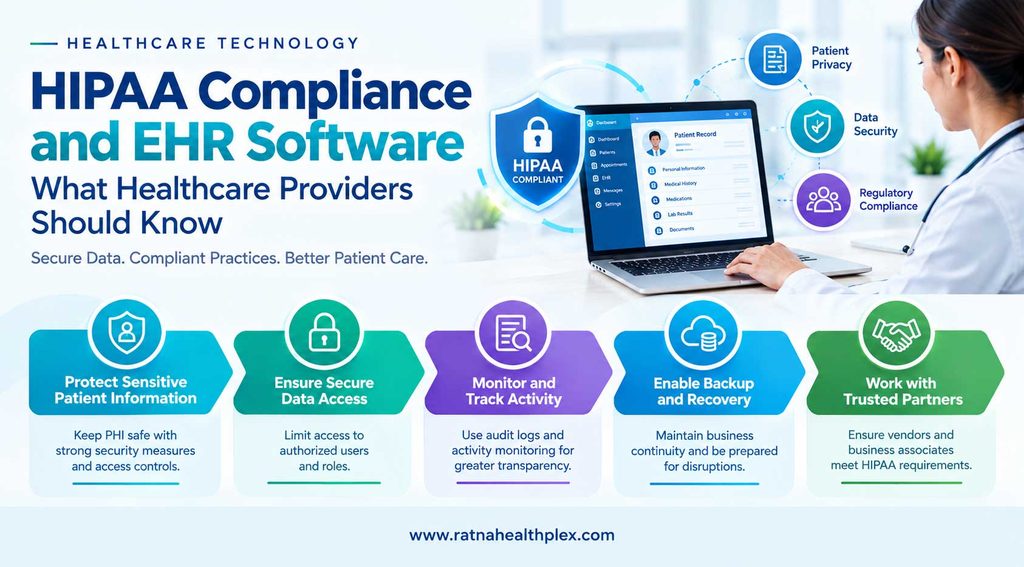
Introduction
Protecting patient information is a critical responsibility for healthcare organizations in the United States. As medical practices increasingly rely on Electronic Health Record (EHR) systems to manage patient data, maintaining privacy, security, and regulatory compliance has become essential.
The Health Insurance Portability and Accountability Act (HIPAA) establishes requirements for protecting sensitive patient health information. Healthcare providers must understand how their EHR software, internal policies, and security practices work together to safeguard patient records.
In this blog, we explore the relationship between HIPAA and EHR software, key security features to consider, and practical steps healthcare providers can take to strengthen patient data protection.
What Is HIPAA Compliance?
The Health Insurance Portability and Accountability Act (HIPAA) is a US federal law that establishes protections for certain health information.
The HIPAA Privacy Rule governs the use and disclosure of protected health information (PHI), while the HIPAA Security Rule establishes safeguards for electronic protected health information (ePHI).
Healthcare providers, health plans, and healthcare clearinghouses are generally covered entities under HIPAA. Certain vendors that handle protected health information on behalf of covered entities may qualify as business associates and have their own HIPAA obligations.
Compliance involves more than purchasing secure software. Organizations must also implement appropriate policies, procedures, workforce training, and safeguards.
Why Is HIPAA Compliance Important for EHR Software?
EHR systems store and manage sensitive information, including patient demographics, medical histories, diagnoses, medications, and clinical documentation.
Without appropriate safeguards, this information may be exposed through unauthorized access, compromised accounts, system vulnerabilities, or improper data sharing.
A properly selected and configured EHR system can support healthcare organizations by helping them:
- Protect sensitive patient information.
- Restrict access to authorized users.
- Monitor access to electronic health records.
- Support secure information sharing.
- Maintain appropriate records of system activity.
- Improve consistency in healthcare data management.
However, software alone cannot guarantee HIPAA compliance. Healthcare organizations must assess their complete technology environment and operational practices.
Essential EHR Security Features Healthcare Providers Should Consider
1. Role-Based Access Control
Role-based access control allows organizations to assign permissions according to users’ job responsibilities.
For example, physicians, nurses, billing personnel, and administrative staff may require different levels of access to patient information.
Limiting access according to legitimate work requirements helps reduce unnecessary exposure of sensitive data.
2. Data Encryption
Encryption helps protect electronic health information from unauthorized access.
Healthcare providers should evaluate how an EHR system protects information both when it is transmitted between systems and when it is stored.
Encryption should form part of a broader security strategy that includes access controls, secure configurations, and appropriate key management.
3. Audit Logs and Activity Monitoring
Audit logs record relevant activities involving electronic health records, such as access, changes, and other system events.
These records can help organizations investigate suspicious activity, review access patterns, and support security monitoring.
Healthcare providers should assess whether their EHR solution offers appropriate logging, monitoring, and reporting capabilities.
4. Multi-Factor Authentication
Multi-factor authentication (MFA) requires users to verify their identity using more than one authentication factor.
It can help reduce the risk of unauthorized access resulting from stolen or compromised passwords.
Healthcare organizations should evaluate MFA availability and implement appropriate authentication controls for their systems and users.
5. Data Backup and Disaster Recovery
Healthcare organizations need plans to maintain access to essential patient information during system failures, cyber incidents, or other disruptions.
Regular backups, recovery testing, and documented contingency procedures can help reduce downtime and support continuity of care.
Providers should evaluate how their EHR vendor supports backup, restoration, and disaster recovery.
6. Secure Data Sharing and Interoperability
Healthcare providers often need to exchange patient information with laboratories, pharmacies, specialists, and other healthcare organizations.
EHR systems should support appropriate safeguards for information exchange, including access management and secure transmission.
Organizations must also ensure that information sharing complies with applicable privacy requirements.
How Healthcare Providers Can Evaluate EHR Software for HIPAA Compliance
Before selecting an EHR solution, healthcare organizations should consider the following steps:
Step 1: Review Security Capabilities
Evaluate authentication, access permissions, audit logging, encryption, backup procedures, and security monitoring.
Step 2: Understand Vendor Responsibilities
Determine whether the vendor may qualify as a business associate and, where required, establish a Business Associate Agreement (BAA).
A BAA helps define the business associate’s permitted uses and disclosures of PHI and its responsibilities for safeguarding information.
Step 3: Conduct a Risk Analysis
Identify potential risks to the confidentiality, integrity, and availability of electronic protected health information.
Use the findings to determine appropriate security measures and address identified vulnerabilities.
Step 4: Establish Internal Policies
Develop policies covering user access, password management, incident reporting, workforce responsibilities, and the appropriate use of patient information.
Step 5: Train Healthcare Staff
Provide regular training so employees understand privacy requirements, recognize phishing attempts, and follow established security procedures.
Step 6: Review and Improve Security Practices
Periodically evaluate security controls, vendor arrangements, user permissions, and incident response procedures.
HIPAA compliance requires ongoing attention rather than a one-time software implementation.
How Ratna HealthPlex Can Support Healthcare Technology Needs
Healthcare organizations need technology solutions that support efficient clinical workflows and responsible patient information management.
Ratna HealthPlex provides healthcare software solutions intended to support healthcare operations. When evaluating any EHR or hospital management platform, providers should assess its available security controls, data management capabilities, integration options, and suitability for their operational requirements.
Healthcare organizations considering Ratna HealthPlex should confirm the availability and configuration of relevant security features and determine whether the solution meets their specific regulatory and contractual requirements.
Conclusion
HIPAA compliance and EHR security are closely connected, but compliance depends on more than software alone. Healthcare providers must combine appropriate technology, risk management, internal policies, workforce training, and ongoing monitoring to protect electronic protected health information.
Looking for healthcare technology solutions? Explore Ratna HealthPlex to learn more about its healthcare software offerings and determine whether they align with your organization’s operational and security requirements.

VP, Marketing, RatnaGlobalTech.