
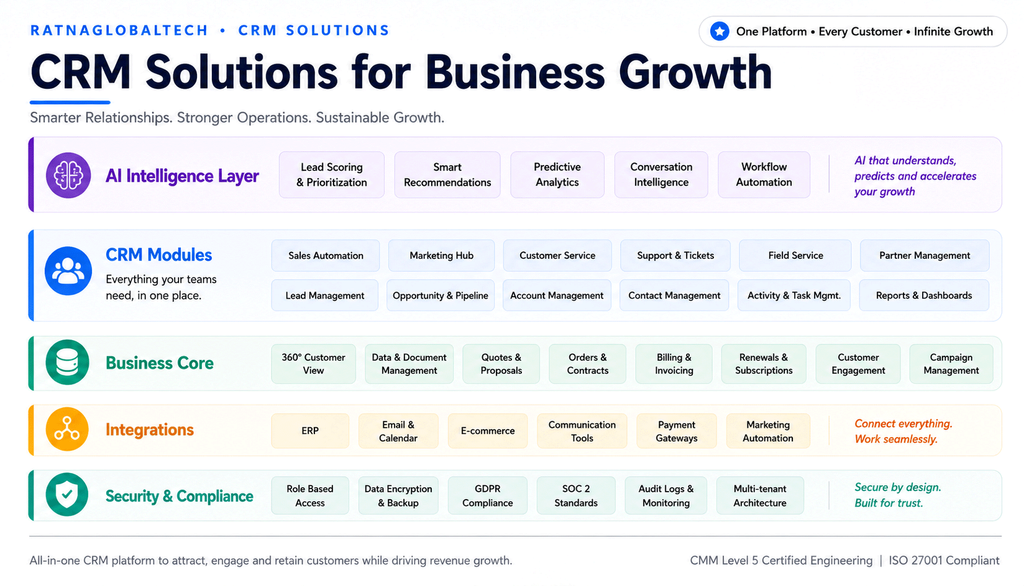
In today’s competitive business environment, growth is no longer driven by acquiring customers alone. Businesses need to understand their customers, respond faster, personalize interactions, and build relationships that continue long after the first sale.
This is where Customer Relationship Management (CRM) becomes a strategic business advantage.
A modern CRM solution brings customer information, sales activities, marketing interactions, service requests, and business insights into a connected environment. With automation, analytics, AI, and integrations, CRM platforms can help organizations move from simply managing customer data to actively using it to drive growth.
For businesses looking to scale, the question is no longer simply:
“Do we need a CRM?”
Instead, the more important question is:
“How can we make our CRM work harder for our business?”
Why CRM Has Become a Growth Engine
Traditional customer management often depends on spreadsheets, emails, disconnected applications, and manually maintained records. As a company grows, these processes can create data silos, missed opportunities, inconsistent follow-ups, and limited visibility into the sales pipeline.
A modern CRM changes this approach by creating a centralized view of customer and prospect information.
Sales teams can track leads and opportunities. Marketing teams can understand customer engagement. Service teams can access interaction history. Business leaders can monitor performance through dashboards and analytics.
The result is a more connected approach to customer management.
Modern CRM platforms increasingly combine centralized customer data with AI and automation across sales, marketing, service, and commerce.
1. Turn Customer Data into Actionable Insights
Businesses generate enormous amounts of customer data every day.
The challenge is not collecting the data—it is knowing what to do with it.
A CRM solution can consolidate information such as:
- Customer profiles
- Lead sources
- Sales interactions
- Purchase history
- Customer communications
- Service requests
- Campaign engagement
- Opportunity status
- Customer preferences
When this information is available in one place, teams can make decisions based on a more complete understanding of the customer.
With analytics and AI capabilities, organizations can go a step further by identifying patterns, forecasting opportunities, and highlighting customers who may need attention.
Data becomes valuable when it leads to action.
2. Improve Lead Management and Sales Conversion
One of the biggest advantages of CRM is better control over the sales pipeline.
Instead of manually tracking prospects across spreadsheets and emails, sales teams can manage leads through clearly defined stages.
A CRM can help organizations:
- Capture leads from multiple sources
- Automatically assign leads to sales representatives
- Track follow-ups
- Monitor opportunity stages
- Identify stalled deals
- Automate routine communications
- Forecast potential revenue
- Measure sales performance
This creates greater visibility into the customer journey.
Sales teams can spend less time searching for information and more time engaging with prospects.
3. Automate Repetitive Business Processes
Business growth often brings operational complexity.
As the number of customers, leads, employees, and transactions increases, manual processes become increasingly difficult to manage.
CRM automation can help reduce repetitive tasks such as:
- Lead assignment
- Follow-up reminders
- Email notifications
- Customer onboarding
- Task creation
- Sales alerts
- Service escalation
- Data updates
- Reporting
Automation allows employees to focus on activities that require human judgment, relationship building, and strategic thinking.
For growing organizations, this can make scalability much easier.
4. Create More Personalized Customer Experiences
Customers increasingly expect businesses to understand their needs.
A generic interaction may no longer be enough.
CRM systems provide teams with access to customer history and interactions, helping them deliver more relevant experiences.
For example, a sales representative can understand previous conversations before contacting a prospect. A customer service agent can view previous support interactions. Marketing teams can segment audiences based on customer behavior.
This creates a more consistent customer experience across departments and channels.
A modern CRM can provide a 360-degree customer view, supporting more personalized engagement and faster service.
5. Connect Sales, Marketing, and Customer Service
One of the biggest challenges businesses face is departmental data fragmentation.
Marketing may generate leads.
Sales may manage opportunities.
Customer service may handle support requests.
But if these teams work with disconnected systems, important customer information can remain trapped within individual departments.
CRM helps create a shared customer information layer.
This allows organizations to connect:
Marketing → Sales → Service → Retention → Growth
When teams work from connected data, customers receive more consistent communication while management gains a clearer picture of the complete customer lifecycle.
6. Make Better Decisions with CRM Analytics
Growth requires informed decision-making.
CRM analytics can help business leaders answer questions such as:
- Which channels generate the most valuable leads?
- Which sales representatives are performing best?
- Where are opportunities getting stuck?
- Which customers are most engaged?
- What is the current sales pipeline worth?
- Which products or services generate the most opportunities?
- Where are customer retention challenges occurring?
Interactive dashboards and reports can turn complex customer and sales data into actionable business insights.
Instead of relying solely on assumptions, organizations can use measurable information to guide their strategies.
7. Use AI to Make CRM More Intelligent
The next evolution of CRM is increasingly connected to artificial intelligence.
AI can help organizations identify patterns, automate tasks, generate insights, support forecasting, and improve customer interactions.
For example, AI-enabled CRM capabilities can assist with:
- Lead scoring
- Sales forecasting
- Customer segmentation
- Opportunity prioritization
- Automated summaries
- Personalized recommendations
- Sentiment analysis
- Predictive customer insights
- Intelligent workflow automation
This changes CRM from a system that simply stores customer information into a platform that can help teams understand what to do next.
The combination of CRM, AI, and automation is becoming increasingly important as organizations look to improve customer experiences and sales performance.
8. Integrate CRM with Your Existing Technology
CRM should not operate as another isolated system.
For maximum value, it should connect with the technologies businesses already use.
Depending on business requirements, CRM integrations can include:
- ERP systems
- Marketing automation platforms
- Email platforms
- Customer support systems
- E-commerce platforms
- Business intelligence tools
- Cloud applications
- Communication platforms
- Data analytics systems
Integration helps create a connected technology ecosystem where information can move between applications more efficiently.
9. Build a CRM Strategy Around Business Goals
Technology alone does not guarantee business growth.
Your CRM strategy needs to be aligned with your organizational objectives.
Before implementing or upgrading a CRM, businesses should identify the following:
Business Objectives
What outcomes are you trying to achieve?
Customer Journey
How do prospects move from awareness to purchase and retention?
Sales Process
Which activities should be automated or standardized?
Data Requirements
Which customer information is critical for decision-making?
Integrations
Which existing systems need to connect with the CRM?
Analytics
Which KPIs should management monitor?
A CRM built around these requirements is more likely to deliver measurable business value.
What Businesses Should Look for in a Modern CRM
Choosing the right CRM platform requires looking beyond basic contact management.
Businesses should consider capabilities such as:
Scalability
The platform should grow alongside the organization and support increasing customers, users, transactions, and business processes.
Automation
Routine tasks and workflows should be automated wherever possible to improve efficiency and reduce manual effort.
Integration
The CRM should connect with the organization’s broader technology ecosystem.
Analytics
Teams should have access to meaningful dashboards, reports, and actionable business insights.
AI Capabilities
AI should support smarter decision-making, productivity, forecasting, and customer engagement.
Customization
Workflows and processes should be adaptable to specific business requirements.
Security
Customer and business data should be managed securely with appropriate access controls and governance.
User Experience
The platform should be intuitive enough for teams to adopt and use consistently.
Salesforce and Zoho: Building CRM Around Your Business
Different organizations have different CRM requirements.
At Ratna Global Technologies, CRM solutions can be designed around business processes, technology environments, and growth objectives.
Our ecosystem includes leading CRM technologies such as Salesforce and Zoho, enabling organizations to explore solutions that align with their operational requirements.
Rather than treating CRM as simply another software implementation, the focus should be on creating a connected business platform that supports:
- Sales
- Customer engagement
- Automation
- Analytics
- Integration
- Long-term business growth
The Future of CRM Is Intelligent, Connected, and Customer-Centric
CRM is evolving from a database for customer records into an intelligent business platform.
The future of CRM will increasingly involve:
Connected Data + Automation + AI + Analytics + Human Expertise
Businesses that successfully bring these capabilities together can create more efficient processes, improve customer engagement, identify opportunities faster, and make better-informed decisions.
The real value of CRM is not the software itself.
It is what the business can accomplish with the intelligence, automation, and customer visibility that the software provides.
How Ratna Global Technologies Can Help
At Ratna Global Technologies, we help businesses leverage modern technology to improve operations, strengthen customer relationships, and support sustainable growth.
Our CRM capabilities focus on creating solutions that align technology with business objectives—from CRM implementation and customization to integration, automation, analytics, and ongoing optimization.
Whether your organization is implementing CRM for the first time, replacing legacy systems, or looking to unlock greater value from an existing platform, the right CRM strategy can become a foundation for scalable growth.
Ready to Turn Customer Data into Your Next Business Opportunity?
Explore CRM solutions with Ratna Global Technologies and build a smarter, more connected approach to business growth.

Digital Marketing Manager, RatnaGlobalTech.