
Healthcare is rapidly moving beyond individual hospitals, clinics, laboratories, and disconnected software systems. The next generation of healthcare is connected, intelligent, data-driven, and patient-centric.
A digital healthcare ecosystem brings patients, healthcare providers, laboratories, pharmacies, administrators, and technology platforms together through connected digital infrastructure. By combining AI, cloud computing, data analytics, interoperability, automation, and cybersecurity, healthcare organizations can create more efficient operations and better experiences for patients and providers.
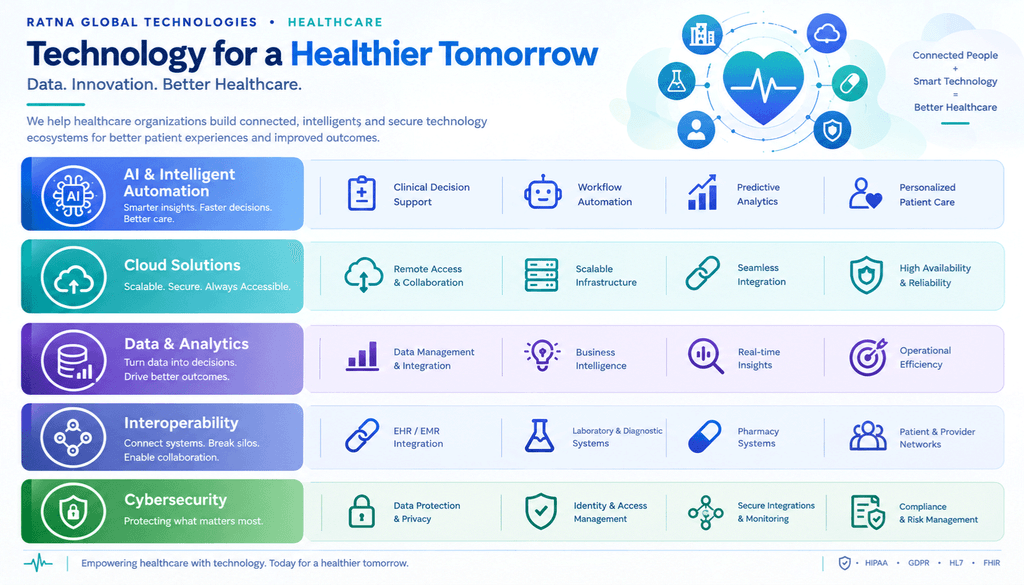
What Is a Digital Healthcare Ecosystem?
A digital healthcare ecosystem is an interconnected technology environment where different healthcare stakeholders and systems can securely exchange information and work together.
Instead of keeping patient information, laboratory results, appointments, billing, pharmacy operations, and clinical workflows in isolated systems, a connected ecosystem enables these processes to communicate and share relevant data.
The goal is simple:
Connect the right people, systems, and data at the right time.
Why Connected Healthcare Matters
Traditional healthcare environments often rely on multiple applications and systems that may not communicate effectively with each other. This can result in:
- Data silos
- Repetitive manual processes
- Delayed access to information
- Administrative inefficiencies
- Limited visibility across operations
- Fragmented patient experiences
A connected digital ecosystem can help healthcare organizations create a more unified flow of information across their operations.
Key Technologies Powering Connected Healthcare
1. Artificial Intelligence
AI is becoming an important component of modern healthcare technology. It can support areas such as:
- Predictive analytics
- Clinical decision support
- Workflow automation
- Patient engagement
- Intelligent data analysis
When implemented responsibly, AI can help healthcare organizations transform large volumes of data into useful insights.
2. Cloud Computing
Cloud technology provides healthcare organizations with scalable infrastructure for applications, data, and digital services.
Cloud-based platforms can support:
- Remote accessibility
- Scalability
- Data integration
- Application modernization
- Collaboration across locations
This makes cloud computing an important foundation for connected healthcare.
3. Healthcare Data & Analytics
Healthcare generates enormous amounts of data—from electronic health records and laboratory reports to operational and financial information.
Advanced analytics can help organizations identify patterns, monitor performance, and make more informed decisions.
Data becomes more valuable when it can be transformed into actionable insight.
4. Interoperability
Connected healthcare depends on systems being able to exchange and use information effectively.
Interoperability can help connect different healthcare applications, including:
- EHR/EMR systems
- Laboratory systems
- Pharmacy systems
- Patient portals
- Diagnostic platforms
- Hospital management systems
A stronger interoperability framework can reduce information silos and support smoother healthcare workflows.
5. Automation
Healthcare organizations manage numerous repetitive administrative processes.
Automation can help streamline activities such as:
- Appointment workflows
- Data entry
- Notifications
- Reporting
- Document processing
- Administrative workflows
This can allow healthcare professionals and staff to focus more time on higher-value activities.
Connecting Patients and Providers
Patient experience is at the center of a connected healthcare ecosystem.
Digital platforms can bring together different touchpoints across the patient journey—from appointment scheduling and consultation to diagnostics, prescriptions, payments, follow-ups, and access to health information.
For healthcare providers, access to relevant information through connected systems can support more coordinated workflows and improved operational visibility.
The Importance of Healthcare Cybersecurity
As healthcare becomes increasingly digital, protecting sensitive information becomes equally important.
Healthcare technology environments need strong security practices covering:
- Data protection
- Identity and access management
- Secure integrations
- Network security
- Compliance
- Monitoring and risk management
A connected ecosystem should not only be intelligent and accessible—it must also be secure.
From Digital Systems to Intelligent Ecosystems
The future of healthcare isn’t simply about replacing paper with software.
It is about creating an ecosystem where technology, data, people, and processes work together.
The combination of AI, cloud, analytics, interoperability, automation, and cybersecurity can help healthcare organizations move from fragmented systems toward more connected and intelligent operations.
How RGT Supports Healthcare Digital Transformation
At Ratna Global Technologies, we help organizations explore and implement technology solutions designed around their evolving digital needs.
Our capabilities across AI, data management, analytics, cloud, cybersecurity, CRM, automation, and digital transformation can support healthcare organizations as they work toward more connected technology environments.
The future of healthcare will be increasingly connected—and organizations that build the right digital foundation today will be better positioned to adapt to what comes next.
Conclusion
Connected healthcare is not a single technology. It is an ecosystem of people, platforms, data, and intelligent technologies working together.
As healthcare continues to evolve, the focus will increasingly shift from isolated digital solutions to integrated ecosystems that enable better connectivity, smarter decisions, streamlined operations, and more patient-centric experiences.
The future of healthcare isn’t just digital. It’s connected.

VP, Marketing, RatnaGlobalTech.