
Introduction
The healthcare industry is undergoing a significant digital transformation. Patients increasingly expect convenient access to medical professionals, while hospitals and clinics are looking for ways to improve operational efficiency, streamline clinical workflows, and deliver more connected care.
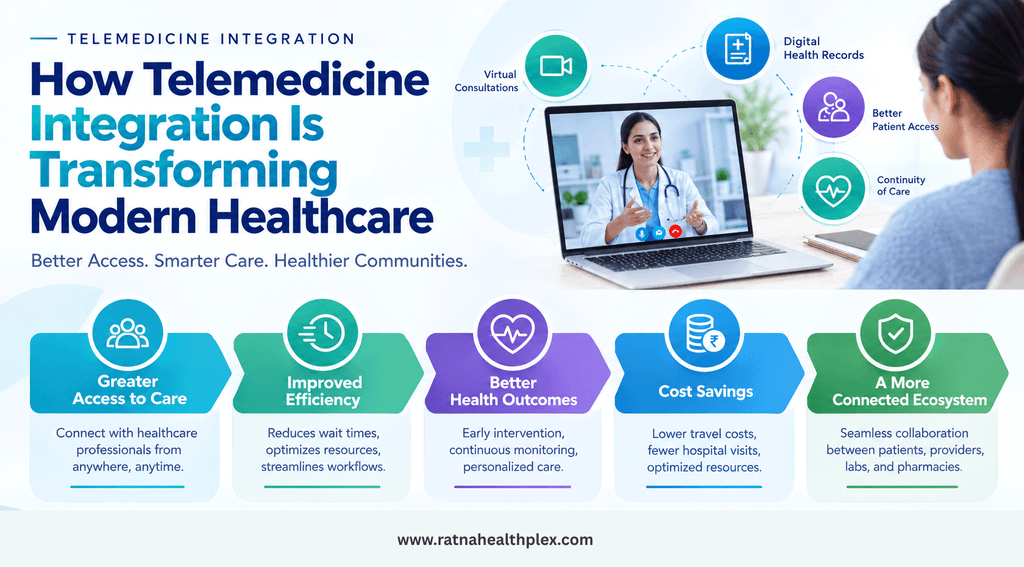
Telemedicine has emerged as an important part of this transformation by enabling healthcare providers to deliver consultations remotely through digital platforms. However, the real value of telemedicine goes beyond video consultations. When integrated with electronic health records (EHR), electronic medical records (EMR), appointment scheduling systems, billing platforms, and other healthcare applications, telemedicine becomes a more connected part of the healthcare delivery process.
In this article, we explore how telemedicine integration is transforming modern healthcare, its key benefits, common challenges, and the role of integrated healthcare technology in building more efficient care delivery systems.
What Is Telemedicine Integration?
Telemedicine integration is the process of connecting telemedicine platforms with other healthcare applications and information systems. These connections allow relevant patient information and clinical workflows to move between systems more efficiently.
Instead of managing virtual consultations through a separate application, healthcare providers can connect telemedicine functionality with their existing digital infrastructure.
A well-integrated telemedicine solution may connect with:
- EHR and EMR systems: Access relevant patient histories, diagnoses, medications, and clinical notes.
- Appointment scheduling systems: Manage virtual appointments, availability, reminders, and cancellations.
- Billing and payment platforms: Support consultation billing and payment workflows.
- E-prescription systems: Enable prescription workflows where supported by the platform and applicable regulations.
- Laboratory and diagnostic systems: Help coordinate orders and access available results.
- Patient portals: Give patients convenient access to appointments, instructions, and permitted health information.
- These integrations help create a more connected environment for healthcare providers and patients.
1. Improving Access to Healthcare Services
One of the most important benefits of telemedicine is that it allows patients to consult healthcare professionals without always visiting a physical healthcare facility.
For patients in remote areas, individuals with mobility limitations, and people who have difficulty traveling, virtual consultations can make healthcare more accessible.
Telemedicine integration can further improve access by connecting online appointment booking, patient registration, consultation platforms, and follow-up workflows.
For example, a patient can schedule a virtual appointment, receive a confirmation, attend the consultation, and access relevant follow-up instructions through connected digital systems.
This approach can reduce unnecessary travel and make it easier for healthcare providers to offer services across wider geographical areas.
2. Connecting Telemedicine with EHR and EMR Systems
Patient information is essential for informed clinical decision-making. When telemedicine operates separately from a healthcare provider’s medical records system, staff may need to transfer information manually between applications.
This can create duplicate work, increase the possibility of data-entry errors, and make clinical documentation more difficult to manage.
Integrating telemedicine with EHR or EMR software helps healthcare professionals access relevant patient information within their established workflows.
Depending on the system’s capabilities, integration can support:
- Access to patient medical histories and medication lists.
- Documentation of virtual consultations.
- Recording diagnoses and treatment plans.
- Updating follow-up instructions.
- Maintaining a more consistent longitudinal patient record.
For example, after a virtual consultation, a clinician may document the encounter in the connected EHR instead of maintaining a separate record in the telemedicine application.
The exact workflow depends on the integration design, permissions, and software capabilities.
3. Streamlining Clinical Workflows
Healthcare professionals often work across multiple applications to manage appointments, clinical documentation, prescriptions, and patient communication. Switching between disconnected systems can consume valuable time.
Telemedicine integration helps connect these processes and reduce repetitive administrative tasks.
A connected workflow may include:
- A patient books a virtual appointment.
- The system sends appointment confirmation and reminders.
- Authorized staff access relevant patient information.
- The healthcare professional conducts the consultation.
- The clinician documents the encounter and records the care plan.
- The patient receives appropriate follow-up instructions.
Automating selected steps can help reduce manual coordination and improve consistency.
It is important to remember that automation should support, rather than replace, clinical judgment. Healthcare professionals remain responsible for appropriate clinical decisions and documentation.
4. Supporting Better Patient Engagement
Patient engagement extends beyond the consultation itself. Appointment reminders, access to medical instructions, follow-up communication, and continuity of care all contribute to the patient experience.
Integrated telemedicine platforms can help healthcare providers maintain communication before and after virtual visits.
Depending on the features available, patients may be able to:
- Schedule and manage appointments online.
- Receive reminders before consultations.
- Access consultation summaries and permitted medical records.
- Review follow-up instructions.
- Communicate with healthcare providers through approved channels.
- Participate in remote follow-up appointments.
These capabilities can make healthcare interactions more convenient and help patients stay informed about their care.
However, digital communication should be designed with accessibility and patient preferences in mind, including alternatives for individuals who have limited internet access or difficulty using digital tools.
5. Enabling Remote Follow-Ups and Continuity of Care
Many healthcare journeys involve more than one appointment. Patients may need medication reviews, post-treatment follow-ups, chronic disease management, or discussions about diagnostic results.
Telemedicine integration can support these ongoing interactions by connecting virtual consultations with patient records, appointment scheduling, and follow-up workflows.
For instance, a patient managing a chronic condition may require regular consultations to review symptoms, discuss treatment adherence, or assess progress. An integrated platform can help the care team coordinate appointments and document relevant updates.
When combined with appropriate remote monitoring tools, telemedicine may also support the collection and review of selected health measurements.
Remote consultations are not suitable for every clinical situation. Patients who require physical examinations, emergency care, or in-person diagnostic procedures should be directed to the appropriate service.
6. Strengthening Healthcare Data Interoperability
Healthcare organizations often rely on multiple systems that store different types of patient and operational information. Connecting these systems is essential to reducing information silos.
Interoperability refers to the ability of different applications to exchange and use information meaningfully.
Telemedicine integration may use healthcare interoperability standards and interfaces to exchange information with EHRs, laboratories, pharmacies, and other systems.
Two commonly used healthcare standards are:
HL7: A family of standards used to exchange healthcare information between systems.
FHIR: A modern healthcare data exchange standard that uses structured resources and APIs to support interoperability.
When implemented appropriately, these standards can help systems exchange information more consistently. The specific standards and interfaces required depend on the applications being connected and their technical capabilities.
Improved interoperability can reduce manual data transfer and support more coordinated care across healthcare services.
7. Improving Operational Efficiency
For hospitals and clinics, operational efficiency is an important consideration when adopting digital healthcare solutions.
Disconnected applications can result in duplicate data entry, appointment coordination challenges, fragmented documentation, and additional administrative work.
Telemedicine integration can help address these issues by connecting virtual care with existing operational systems.
- Potential operational benefits include:
- More coordinated appointment management.
- Reduced repetitive administrative tasks.
- Better access to relevant clinical information.
- More consistent consultation documentation.
- Improved visibility into virtual care workflows.
- More structured follow-up processes.
The actual impact depends on system design, staff training, workflow adoption, and the quality of the integration. Healthcare organizations should evaluate these factors when measuring the value of a telemedicine implementation.
8. Prioritizing Patient Data Security and Privacy
Telemedicine involves the exchange of sensitive health information, making privacy and security essential components of implementation.
Healthcare organizations must consider how patient data is collected, transmitted, stored, accessed, and shared across connected applications.
Important security considerations include:
- Access controls: Ensure users can access only the information required for their roles.
- Encryption: Protect information during transmission and, where appropriate, at rest.
- Authentication: Use appropriate identity verification and authentication measures.
- Audit trails: Maintain records of relevant access and system activities.
- Secure APIs: Apply appropriate authentication, authorization, and data-validation controls to integrations.
- Privacy compliance: Evaluate applicable legal and regulatory requirements based on the organization’s location and operations.
For organizations handling US patient information, HIPAA requirements may apply. Healthcare providers operating in India should also assess applicable Indian data protection and healthcare requirements.
Compliance depends on the complete technical, organizational, and operational environment. Integrating a telemedicine platform does not automatically make an organization compliant.
9. Supporting Healthcare Delivery Across Different Locations
Healthcare organizations may operate multiple clinics, hospitals, diagnostic centres, or specialty practices.
When virtual care tools are integrated with suitable healthcare systems, authorized teams can coordinate consultations and access relevant information across locations, subject to permissions and organizational policies.
This can be especially useful for organizations that want to expand virtual services without managing entirely separate workflows for each facility.
For example, a multispecialty clinic may use integrated scheduling and medical records to coordinate virtual follow-ups alongside in-person appointments.
The ability to share information across locations depends on system architecture, data governance, interoperability, and the permissions configured for each user.
How Ratna HealthPlex Can Support Digital Healthcare Transformation
Healthcare organizations need technology that supports their operational requirements while helping connect essential healthcare workflows.
Ratna HealthPlex provides a starting point for organizations exploring digital healthcare solutions and the integration of telemedicine into their broader technology environment.
When evaluating a telemedicine integration project, healthcare providers should consider how virtual consultations can work alongside medical records, appointment scheduling, patient communication, and other essential applications.
The right approach begins with understanding existing workflows, identifying integration requirements, and selecting a solution that can support the organization’s clinical and operational goals.
To explore healthcare technology options for your organization, visit Ratna HealthPlex.
Conclusion
Telemedicine integration is transforming modern healthcare by connecting virtual consultations with electronic health records, appointment scheduling, patient communication, and other essential systems.
When implemented effectively, it can improve access to healthcare, reduce repetitive administrative tasks, support continuity of care, and help organizations coordinate digital and in-person services.
However, successful implementation requires more than connecting applications. Healthcare providers must prioritize interoperability, data security, workflow design, staff adoption, and ongoing performance measurement.
As healthcare continues to evolve, integrated telemedicine solutions can play an important role in building more accessible, coordinated, and digitally connected healthcare services.
Looking to explore digital healthcare integration? Connect with Ratna HealthPlex to discuss your organization’s healthcare technology requirements.

VP, Marketing, RatnaGlobalTech.