
Padmavathi Sanapala, CTO and Chief Architect, RatnaGlobalTech, LinkedIn profile
Most healthcare software fails for a boring reason. It was built for a hospital in general, and hospitals in general do not exist.
An eye care centre runs on refraction charts, IOL calculations and a surgical queue measured in minutes. An occupational health provider runs on OSHA logs, DOT physicals and an employer as the paying customer rather than the patient. A hospice runs on symptom scoring, bereavement follow-up and a plan of care that is deliberately not curative. A home care agency runs on electronic visit verification, caregiver credentials and a GPS signal that sometimes disappears in a Brooklyn stairwell.
Hand all four of them the same generic EMR and you get the same result. The clinical staff open the software, cannot find their workflow, and go back to paper and WhatsApp. The software is not wrong. It is simply not theirs.
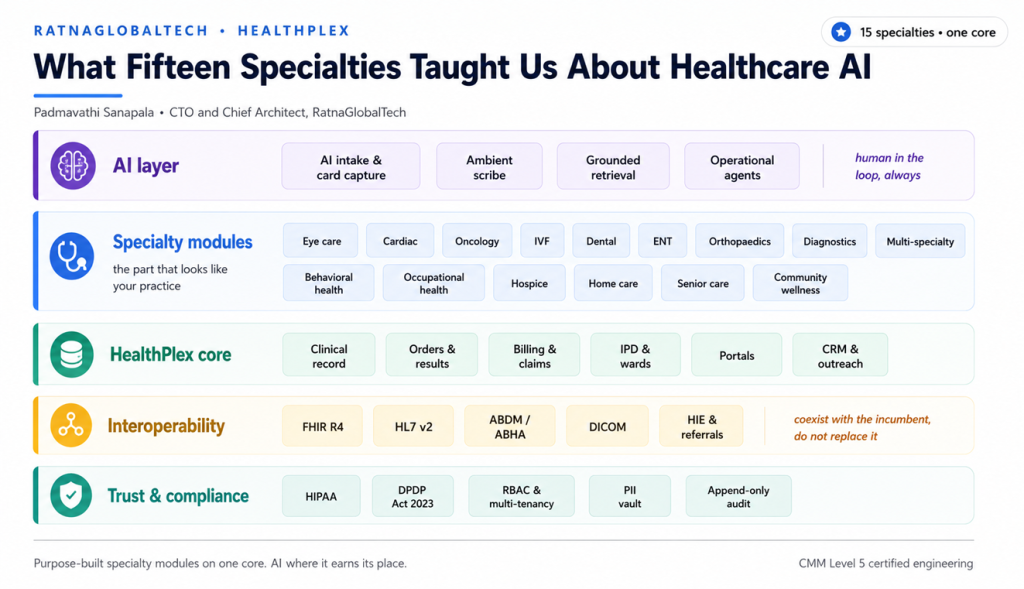
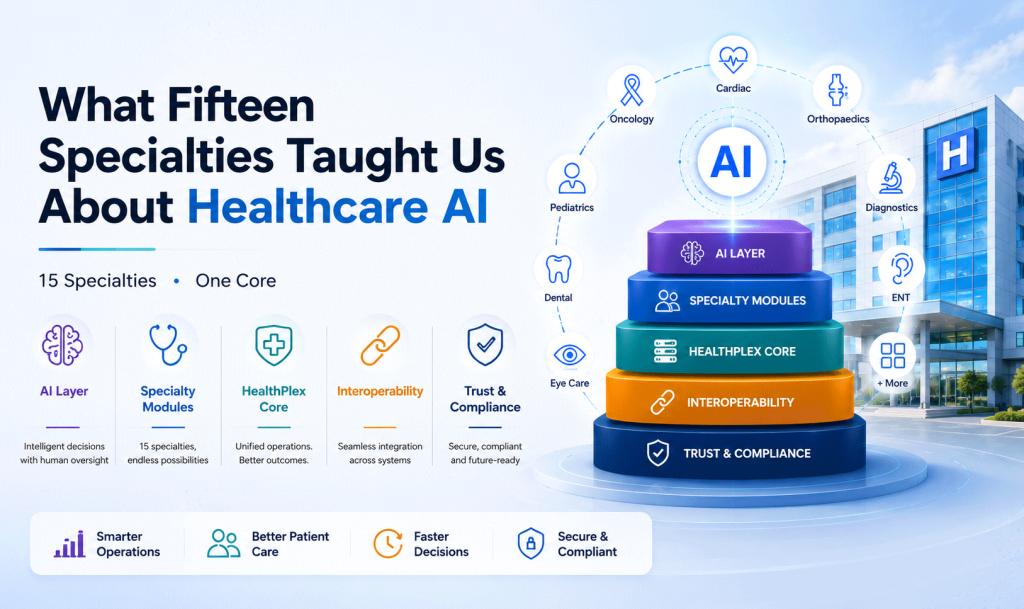
We built HealthPlex around that observation, and over the last two years we have shipped it into eye care, cardiac care, oncology and IVF, dental, ENT, orthopaedics, diagnostics, behavioural health, occupational health, community wellness, hospice, senior care and home care. Fifteen or so specialties, depending on how you count. Along the way we learned a fair amount about where AI genuinely belongs in a clinical system, and where it very much does not.
The module is the unit of value, not the platform
We stopped selling a platform some time ago. Nobody buys a platform. A clinic director buys the thing that removes the two hours of documentation sitting between her and dinner.
So HealthPlex is composed as a set of purpose-built sector modules on a shared core. The core carries what every provider needs and nobody enjoys building: registration and identity, appointments, the clinical record, orders, pharmacy and inventory, billing and claims, ward and IPD management, diagnostics, patient portal, doctor portal, CRM, reporting, consent and audit.
The sector modules carry the parts that make a provider recognise their own practice on screen. Occupational health gets employer dashboards, injury case management and workers’ compensation billing. Hospice gets interdisciplinary team notes and bereavement tracking. Home care gets EVV, split shifts, authorisation burn-down and caregiver matching against hard rules. Dental gets an odontogram and treatment plan phasing. ENT gets audiometry and endoscopy capture inside the OPD flow.
The engineering discipline that makes this affordable is unglamorous: sixteen plus Spring Boot microservices, strict multi-tenancy, RBAC enforced at the service boundary rather than the screen, a PII vault for identifiers, versioned migrations, and an event ledger that lets any module subscribe to what happened elsewhere without a point-to-point integration. New specialty, new module, same spine.
Where AI has actually earned its place
There is a great deal of noise in this market right now. Filtering it down to what has survived contact with real users in our deployments, four categories hold up.
Intake and registration. Scanning a government ID and an insurance card, extracting the fields, and pre-filling the registration form is a small feature with a large effect. It cuts a five minute front desk interaction to under a minute and removes the transcription errors that later become claim denials. The rule we enforce: if a human edits an extracted field, the edit wins permanently and the model never overwrites it.
Ambient documentation. A scribe that listens to the consultation and drafts the note is the single most requested feature we get from physicians, in India and in the US alike. It works because the model is doing what models are good at, which is turning unstructured speech into structured draft text, and because a clinician still signs the note. We built the same primitive for a Chicago child welfare nonprofit as voice transcription with dialogue condensing, under a state restriction that prohibits AI from making any determination about a child or family. The transcript is assistive. The decision is human. That constraint made the product better, not weaker.
Retrieval over your own clinical corpus. A general purpose model that has never read your protocols is a search engine with good manners. Pointing a medical model at your own guidelines, formulary, prior authorisation rules and past notes through a proper retrieval pipeline is what makes an answer trustworthy and citable. Our current work here pairs a medical model with a vector store so that every response can be traced to the document that produced it.
Operational agents. The least discussed and possibly the highest return. Follow-up reminders that escalate to a team leader when they go overdue. Denial patterns surfaced before the month closes. Authorisation burn-down with a reauthorisation projection. Credential expiries flagged before a caregiver is scheduled into a visit she is no longer qualified for. None of this is clinical AI. All of it pays for itself.
Where AI does not belong yet
We do not let a model make a clinical determination, close a claim, or take an irreversible action without a human in the loop. Not because the technology cannot, in narrow cases, do it. Because healthcare is a domain where the cost of being confidently wrong is measured in harm, and where regulators are correctly unwilling to accept a shrug and a temperature setting as an explanation.
Three practical rules we hold to:
- Every AI action writes an audit record showing the input, the output, the model and the human who accepted or overrode it.
- Any AI-generated content is visually distinguishable from human-entered content until it is signed.
- Consent and data residency constraints apply to model calls exactly as they apply to any other data processing. If a tenant’s data cannot leave a jurisdiction, neither can its inference.
Interoperability is the actual moat
The most common conversation we have with a US prospect is not about features. It is about the incumbent. They have Epic or Cerner. They are not replacing it, and they should not.
We have found the winning posture is coexistence rather than displacement. HealthPlex sits alongside the system of record as a specialty layer, exchanges through HL7 v2 and FHIR, and gives the practice the workflow depth the enterprise EMR was never going to build for a twelve provider orthopaedic group. In India, the equivalent conversation is ABDM and ABHA linkage, and the answer is the same. Speak the standards properly, write to the shared record, and stop asking the customer to rip out an eight figure investment to buy a six figure one.
Compliance is a build-time concern
HIPAA in the US, the DPDP Act 2023 in India, and increasingly both for anyone operating across the two. We treat these as architecture, not paperwork. Consent management, data subject access and deletion, field level encryption for identifiers, tenant isolation and an append-only audit trail were built into the core rather than bolted on ahead of an assessment. The unpleasant truth is that retrofitting consent into a mature schema costs several times what building it in costs, and the migration is where the breaches happen.
The part nobody blogs about
We ship a lot of software with a hundred plus engineers, and the thing that actually keeps quality high is test automation that scales faster than the feature count. That is why we built our own AI-native testing platform and use it on our own products before we sell it to anyone. Every demo and every module we ship carries an automated suite. When a module grows to thirty screens, the suite is the only reason anybody sleeps.
CMM Level 5 certification is often treated as a procurement box. For us it is mostly a forcing function. It means the review, the traceability and the defect discipline happen whether or not the sprint is comfortable.
What we are building next
Three things are on the bench right now. A diagnostics module with a DICOM bridge, so imaging flows from the modality to the record and to the patient without a physical film or a CD. Remote monitoring and telehealth wired into the same clinical thresholds a nurse already configured, so a device reading that crosses a line becomes a task rather than a chart. And a deeper retrieval layer over each tenant’s own clinical content, because the next useful step in healthcare AI is not a larger model, it is a better grounded one.
If you run a hospital, a clinic chain, a diagnostics centre or a care agency and any of this sounds like your week, I would rather have a working conversation than send you a brochure. We usually turn up to the first meeting with a demo built around your actual workflow. It tends to save everyone a lot of time.
Padmavathi Sanapala is CTO and Chief Architect at RatnaGlobalTech, a CMM Level 5 certified software engineering firm. She has 25 plus years in enterprise architecture across telecom, BFSI, healthcare and manufacturing, and leads RGT’s healthcare interoperability, data engineering and applied AI practices.

CTO and ChiefArchitect, RatnaGlobalTech.