
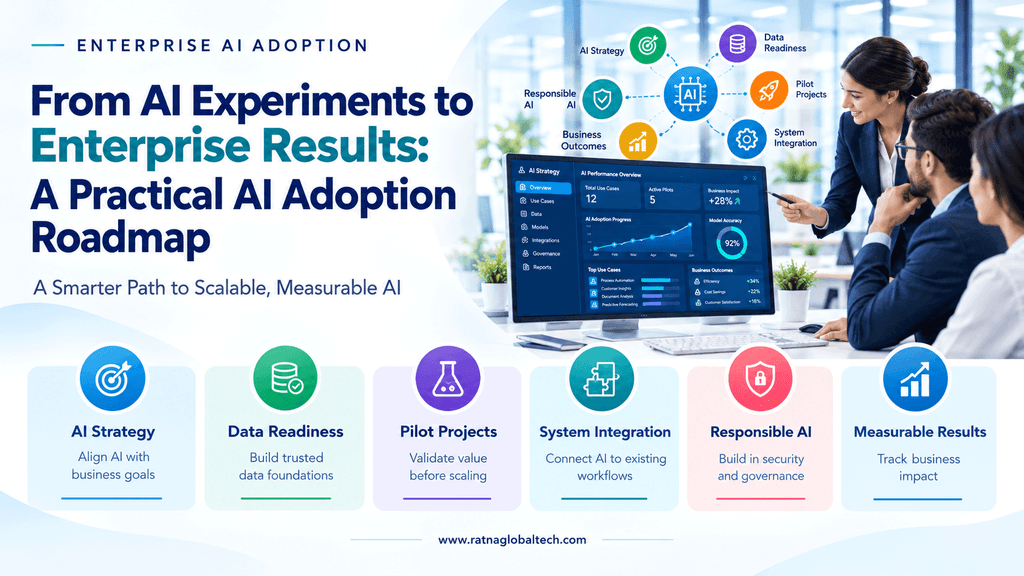
How businesses can turn artificial intelligence initiatives into measurable business value through strategic planning, integration, and responsible implementation.
Introduction: Moving Beyond AI Experimentation
Artificial intelligence (AI) has become a strategic priority for businesses seeking to improve efficiency, accelerate decision-making, and deliver better customer experiences. From generative AI assistants to predictive analytics and intelligent automation, organizations have more opportunities than ever to integrate AI into everyday operations.
However, experimenting with AI tools is not the same as achieving meaningful business outcomes.
Many organizations begin with isolated pilots, employee-led experiments, or standalone AI applications. While these initiatives can demonstrate potential, they often struggle to progress into production systems that deliver consistent, measurable value.
The real challenge is not simply adopting AI. It is identifying the right opportunities, preparing data and infrastructure, integrating AI into existing workflows, and establishing the governance needed to scale it responsibly.
For enterprise leaders, the path forward requires a structured AI adoption roadmap that connects technology investments with business objectives.
Why AI Experiments Often Fail to Deliver Enterprise Value
AI experimentation can generate valuable insights, but organizations may encounter several obstacles when moving from proof of concept to enterprise-wide implementation.
1. Unclear Business Objectives
Some AI initiatives begin because technology is trending rather than because a specific business problem needs solving.
Without clearly defined objectives, teams may struggle to determine whether an AI solution improves productivity, reduces operational costs, increases revenue, or enhances customer satisfaction.
The solution: Define the business problem first, then determine whether AI is the appropriate solution.
2. Fragmented and Inaccessible Data
AI systems depend on reliable, relevant data. When information is scattered across disconnected applications, outdated databases, and departmental systems, it becomes difficult to build dependable AI solutions.
Organizations need a data strategy that addresses quality, accessibility, integration, and governance before scaling complex AI initiatives.
3. Limited Integration with Existing Workflows
An AI tool may perform well in a demonstration but deliver limited value if employees must switch between multiple applications or manually transfer information.
Enterprise AI should complement existing business processes and integrate with relevant CRM platforms, cloud environments, analytics systems, and operational applications.
4. Security, Governance, and Trust Concerns
AI introduces important considerations around sensitive information, access permissions, inaccurate outputs, bias, accountability, and regulatory obligations.
Without appropriate safeguards, these concerns can slow adoption and undermine user confidence.
5. No Clear Measurement of Success
If organizations do not establish performance baselines and measurable targets, they cannot reliably determine whether an AI initiative is worth expanding.
A successful implementation should demonstrate business impact—not merely technical functionality.
A Practical Five-Stage Roadmap for Enterprise AI Adoption
Moving from experimentation to measurable results requires a phased approach. Each stage should establish the evidence and capabilities needed for the next.
Stage 1: Identify Business Opportunities and Define Outcomes
Begin by identifying operational challenges where AI can create meaningful value.
Look for repetitive tasks, information-intensive workflows, slow decision-making processes, customer service bottlenecks, and activities that require substantial manual effort.
Potential use cases include:
- Automating document processing and information extraction.
- Improving customer support through AI-assisted knowledge retrieval.
- Forecasting demand using historical business data.
- Enhancing software quality through automated test generation.
- Identifying patterns in operational and business performance.
- Supporting employees with intelligent search and knowledge assistants.
Evaluate each opportunity based on business impact, implementation of feasibility, data availability, risk, and alignment with strategic goals.
Key deliverable: A prioritized list of AI use cases with clearly defined business objectives and success metrics.
Stage 2: Assess Data, Infrastructure, and AI Readiness
Before selecting an AI model or platform, assess whether the organization has the foundations needed to support the proposed use case.
Consider the following areas:
Data readiness: Is the required information accurate, accessible, sufficiently representative, and appropriately governed?
Technology readiness: Can existing applications, databases, and cloud infrastructure support the solution?
Security readiness: Are access controls, data protection measures, and monitoring practices in place?
People readiness: Do employees and technical teams have the skills needed to implement and use the solution effectively?
Is there a clear owner responsible for performance, maintenance, and ongoing improvement?
This assessment helps organizations identify gaps before they become expensive implementation problems.
Key deliverable: An AI readiness assessment and an actionable plan for addressing technical, data, and organizational gaps.
Stage 3: Start with a Focused Pilot
Rather than attempting a company-wide AI transformation immediately, begin with a clearly scoped pilot.
Select a use case that offers meaningful business value while remaining manageable in terms of complexity and risk.
For example, an organization could introduce an AI assistant that helps employees retrieve information from approved internal documentation. The pilot can test whether the assistant provides useful answers, respects access permissions, and reduces the time required to find information.
During this stage:
- Establish baseline performance before implementation.
- Define measurable success criteria.
- Test outputs for accuracy, consistency, and reliability.
- Evaluate security and data handling.
- Collect feedback from intended users.
- Document limitations, costs, and improvement opportunities.
A pilot should answer a practical question: Does this solution work well enough, safely enough, and economically enough to justify further investment?
Key deliverable: A pilot evaluation supported by performance data, user feedback, and a clear recommendation to proceed, revise, or stop.
Stage 4: Integrate AI into Enterprise Systems and Workflows
Once a pilot demonstrates sufficient value, the next step is to integrate the solution into real business operations.
This may involve connecting AI capabilities with CRM platforms, enterprise databases, cloud services, business intelligence tools, or custom applications.
For example, an AI-powered CRM workflow might help sales teams summarize customer interactions, identify relevant account information, and prepare follow-up recommendations. Employees should remain able to review outputs and make appropriate decisions.
Enterprise integration should address:
- Secure APIs and application connectivity.
- Identity management and role-based permissions.
- Data quality and synchronization.
- Testing, reliability, and performance.
- Human review and escalation procedures.
- Version management and ongoing maintenance.
The objective is to make AI useful within existing workflows rather than creating another disconnected technology layer.
Key deliverable: A production-ready solution with defined ownership, operational controls, integration testing, and support procedures.
Stage 5: Measure, Monitor, and Scale
AI adoption does not end at deployment. Business needs, data, models, and user expectations evolve over time.
Organizations should monitor performance continuously and expand successful use cases based on evidence.
Useful metrics include:
| Business objective | Example measurement |
| Improve productivity | Time saved per task |
| Reduce operating costs | Cost per completed process |
| Enhance customer experience | Resolution time and satisfaction |
| Improve quality | Error rate and rework |
| Support better decisions | Forecast accuracy or decision turnaround time |
| Encourage adoption | Active users and repeat usage |
| Maintain reliability | Failure rate and service availability |
Establish baselines before implementation and compare results over an appropriate period. Where possible, use controlled comparisons to distinguish AI-related improvements from other operational changes.
Scaling should also include employee training, feedback mechanisms, updated documentation, risk reviews, and clear accountability.
Key deliverable: An ongoing AI optimization plan tied to business performance and operational requirements.
Responsible AI: Build Trust into Every Stage
Responsible AI practices should be incorporated from the beginning rather than introduced only after deployment.
Organizations can use the voluntary NIST AI Risk Management Framework as a reference for identifying and managing AI risks. Its core functions are Govern, Map, Measure, and Manage. These provide a useful structure for assessing risks throughout the AI lifecycle.
Important considerations include:
- Privacy and security: Protect sensitive business and customer information.
- Access controls: Ensure users and AI systems can access only authorized information.
- Accuracy and reliability: Evaluate outputs and monitor performance over time.
- Human oversight: Define when human review or intervention is required.
- Transparency: Communicate relevant limitations and the role of AI in decision-making.
- Accountability: Assign responsibility for system performance, incidents, and ongoing reviews.
The appropriate controls depend on the intended use, the sensitivity of the data, and the potential consequences of an incorrect output.
Choosing the Right AI Technology and Integration Strategy
Successful AI adoption is not about selecting the most advanced model or purchasing the largest number of tools. It is about matching technology to business problems.
Different use cases may require different approaches:
Generative AI: Useful for summarization, content assistance, conversational interfaces, and knowledge retrieval.
Predictive analytics and machine learning: Appropriate for forecasting, classification, anomaly detection, and pattern recognition.
Intelligent automation: Helps streamline repetitive, rule-based, and information-intensive processes.
AI-enabled software quality engineering: Supports activities such as test generation, regression testing, and defect analysis.
Enterprise data and cloud platforms: Provide the infrastructure, integration, and data foundations needed for dependable AI solutions.
Organizations should evaluate these options alongside existing systems, integration requirements, security needs, scalability, and total cost of ownership.
An experienced technology partner can help assess the current environment, prioritize use cases, select suitable architectures, and connect AI capabilities with business applications.
Common Mistakes to Avoid During AI Adoption
Even well-funded AI initiatives can struggle if organizations overlook implementation fundamentals.
Avoid these common mistakes:
- Adopting AI without a defined business problem. Start with measurable operational needs rather than technology trends.
- Scaling before validating results. Establish evidence through focused pilots before making larger commitments.
- Ignoring data quality. Poor source data can undermine otherwise capable AI systems.
- Treating security as an afterthought. Design access controls, privacy protections, and risk assessments into the solution.
- Overlooking employee adoption. Provide training, explain limitations, and incorporate user feedback.
- Measuring activity instead of outcomes. Track business impact rather than the number of AI tools deployed or experiments completed.
- Neglecting ongoing monitoring. Assign ownership for quality, costs, reliability, and changing business requirements.
How Ratna Global Tech Can Support Enterprise AI Initiatives
Turning AI experimentation into enterprise value requires more than access to AI tools. Organizations need the right combination of data foundations, application integration, cloud capabilities, software engineering, and business-focused implementation.
Ratna Global Tech provides IT services and technology consulting across areas including AI, data analytics, cloud management, CRM, business intelligence, DevOps, and quality engineering.
These capabilities can support organizations as they assess their technology environment, identify relevant opportunities, integrate solutions with existing systems, and build a practical path toward scalable digital transformation.
Whether a business is evaluating its first AI pilot or planning to expand an established initiative, the starting point should be the same: define the problem, establish measurable outcomes, and build a solution around real operational needs.
Explore Ratna Global Tech to learn more about its technology services and consulting capabilities.
Conclusion: Turn AI Potential into Measurable Progress
Enterprise AI adoption is a journey from identifying business opportunities to validating solutions, integrating them into workflows, and continuously improving performance.
Organizations that take a structured approach can make more informed investment decisions, manage risks more effectively, and focus resources on initiatives that deliver tangible business value.
The goal is not to implement AI everywhere. It is to apply AI where it solves meaningful problems, earns user trust, and supports measurable business outcomes.
Ready to move beyond AI experimentation? Start by identifying one high-value business challenge and building a practical roadmap to address it.
Connect with Ratna Global Tech to explore how technology consulting, data, cloud, and AI capabilities can support your enterprise transformation journey.

Digital Marketing Manager, RatnaGlobalTech.